Big Bus Las Vegas: Sightseeing Night Tour by Open-Top Bus
Meet at the kerbRecorded commentaryMax 48
From $59 per person
Las Vegas after dark is the rare attraction that is already switched on and already free. The Bellagio fountains, the Fremont Street canopy and the Welcome sign cost nothing and never close, and the boulevard they sit on is a public road. What you are actually planning is movement: four and a bit miles of Strip, five more to downtown, and a night that only gets going once the sun is down.
Sunset in Las Vegas moves from about 4:26pm in the first week of December to about 8:03pm at the end of June. That three-and-a-half-hour swing is the single biggest planning fact here. In midwinter a 5:30pm departure is already running in the dark and you get a full evening out of it; in July the same departure spends its first hour in daylight and the lights only arrive near the end.
Work backwards from the sunset date for your trip and pick a start time that puts you on Las Vegas Boulevard after it. The departures listed on Las Vegas Night ticket prices run from 5:30pm to 10pm, which covers the whole year if you match them to the month rather than to the clock.
Sunset times computed for 36.1147°N, 115.1728°W and checked against published tables for 1 September 2026.
| Month | Sunset, mid-month | What that means for a night tour |
|---|---|---|
| December | 4:27pm | Even a 5:30pm start is fully dark. The best month for an early evening. |
| March | 6:48pm | Clocks have gone forward. A 7pm start catches the last light and then the lights. |
| June | 7:59pm | Only the 8pm and 10pm departures are properly night tours. |
| September | 6:49pm | Back to a comfortable evening, and still warm at 10pm. |
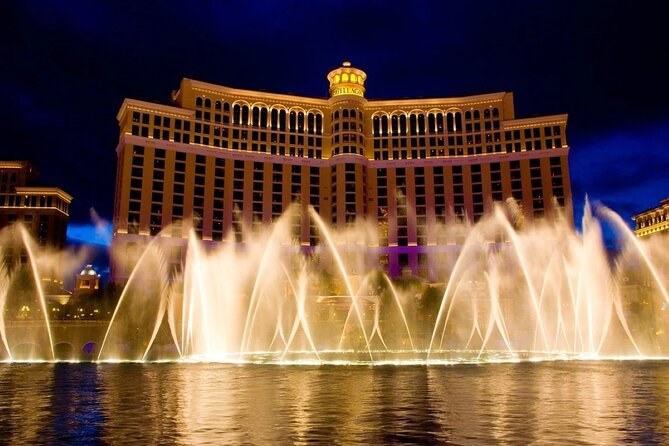
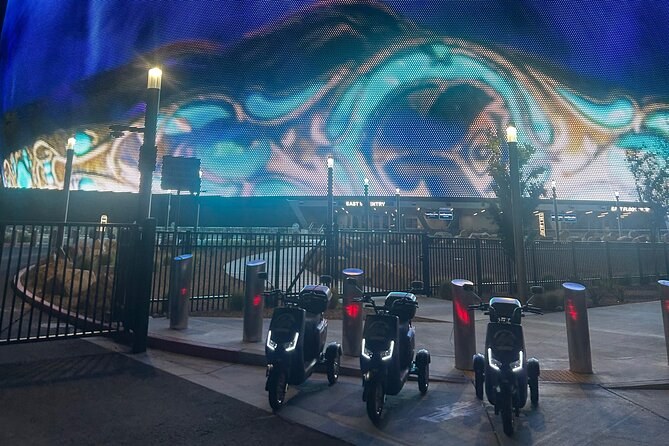
More than most visitors expect, and it is worth knowing before you pay for anything. The Fountains of Bellagio run every 30 minutes through the afternoon and then every 15 minutes from 8pm until midnight, watched from the pavement, weather permitting. The Fremont Street Experience and its Viva Vision shows on the hour from 6pm to 2am are free to walk into. The Welcome to Fabulous Las Vegas sign is lit around the clock with a free car park beside it, and the outside of Sphere costs nothing to look at.
What is not free is the Neon Museum, whose evening admission is $35 for an adult on the museum's own published rates, and the observation decks at the High Roller and The STRAT. The attractions page sets out what each one charges and when it opens.
The Strip runs 4.2 miles along Las Vegas Boulevard and downtown Fremont Street sits about five miles further north, which is the distance people most often underestimate. There is no walkable route between them. The Deuce bus covers the whole boulevard 24 hours a day, roughly every 15 minutes, and a 24-hour pass costs $8. The Monorail is quicker along the east side of the Strip but stops between midnight and 3am depending on the night.
Rideshare works, with one catch worth planning for: the big resorts route pick-ups into a garage that can be a five-minute walk from the casino floor. The map page lays out the geography and the five addresses tours actually leave from.
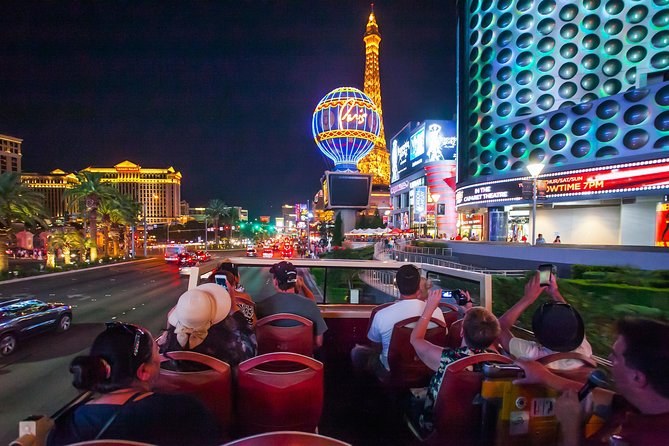
Allow four hours to see both the Strip and downtown properly, and two if you are staying on one of them. The guided vans and jeeps run three to four hours door to door because they stop and walk you around eight or nine times. The open-top bus is two hours in a seat. A helicopter flight is ten to twelve minutes airborne inside a booking of one to two hours, and the club crawls run four hours from a 8pm or 10pm start.
The longer bookings here are rarely more sightseeing — they are a dinner, a transfer or a queue. Read the duration and the time-at-the-attraction figure together rather than the duration alone.
Sixteen departures, compared by what each one actually shows you after dark and whether it collects you from your hotel.
The picture is mixed and the listings are specific about it. Two of the open-top bus products describe themselves as wheelchair accessible and stroller accessible, and the downtown bar tour and the Strip walking tour do the same. The helicopters are not: every flight requires you to board the aircraft, several state that a physically challenged passenger must be accompanied by someone able to lift them, and all of them declare a per-seat weight limit at booking.
The Strip's pavements are wide, level and well lit, and the crossings are pedestrian bridges with lifts at most junctions. Getting between two resorts is rarely the problem; getting across the boulevard at street level is, because it is not permitted in most places along it.
Not always, and it is worth saying so. If you are staying on the Strip and want the fountains, the conservatory and a walk under the neon, the answer is no: put on comfortable shoes, take the Deuce north once, and the evening costs you a bus pass. That is a good night out and nobody needs to sell you a ticket for it.
What a guided departure buys is the parts of the night that are awkward on foot. The Welcome sign is a mile past the last resort with no pavement worth walking. Downtown is five miles away. A helicopter gets you the one view the boulevard cannot give you. A club crawl buys the door rather than the drive. Start with the tours on Las Vegas Night Tours and compare the Las Vegas night tours by what they cover.
Layers, and better shoes than you think. A January evening on an open top deck sits near 40°F with the wind of a moving bus on top of it, and an August evening is still above 90°F at 10pm. The nightclub crawls enforce a dress code at the door: no jerseys, no hats, no athletic wear.
It depends entirely on the format, and the range is wide. The helicopter flights involve almost none, the open-top bus is a seat for two hours, the guided vans and jeeps stop and walk you around eight or nine times, and the Strip walking tour is two hours on foot. The listings that describe a moderate fitness level are the stop-heavy ones.
Some are, and the age rules are firm rather than advisory. The open-top bus, the guided vans and the jeep take children, the jeep sets a minimum age of two, and the helicopters require a paid seat for anyone aged two or over. Every club crawl and bar tour here is 21 and over with photo ID checked at the door.
Yes, on more of these than you would expect. Every passenger aged 18 or over needs original government photo ID to board a helicopter, and a photocopy or a phone image will not do. The nightclubs check physical ID at every door, and visitors from outside the United States are asked for a passport.
On about half of them. The guided vans, the jeep, the sidecar and the wedding flight collect you from your hotel; the open-top buses, the club crawls and two of the helicopter flights start at a fixed address you make your own way to. The cards say which, and the meeting-point block on each tour page gives the address.
On the Strip, an over-21 can walk with an open drink in a plastic, paper or aluminium container, but glass beverage containers are banned there under Clark County Code 12.43.025. The Fremont Street Experience goes further and bans cans as well as glass inside the mall. Read the signs at the entrance to any pedestrian area, because the rules differ street by street.
The Deuce runs the length of Las Vegas Boulevard 24 hours a day, about every 15 minutes, and a 24-hour pass covers it. The Monorail is faster along the east side of the Strip but stops between midnight and 3am depending on the night. Rideshare works, though pick-up points at the big resorts are often in a garage several minutes from the door.
The Strip and the Fremont Street Experience are busy and heavily staffed all evening, and reviewers who travelled alone say the guided options were about company rather than safety. Keep to the lit pedestrian bridges rather than crossing the boulevard at street level, which is illegal in most places along it. The quiet blocks are the ones between the resorts, not the ones in front of them.
Yes, with one caveat that catches people out. Handheld night photographs from a moving open-top bus or jeep rarely come out; the stop-based tours and the two photographer-led walks are the ones that produce keepable images. On the helicopters, photography of the aircraft on the ground is restricted at some operators.
From $59 per person